75D23L Battery Meaning
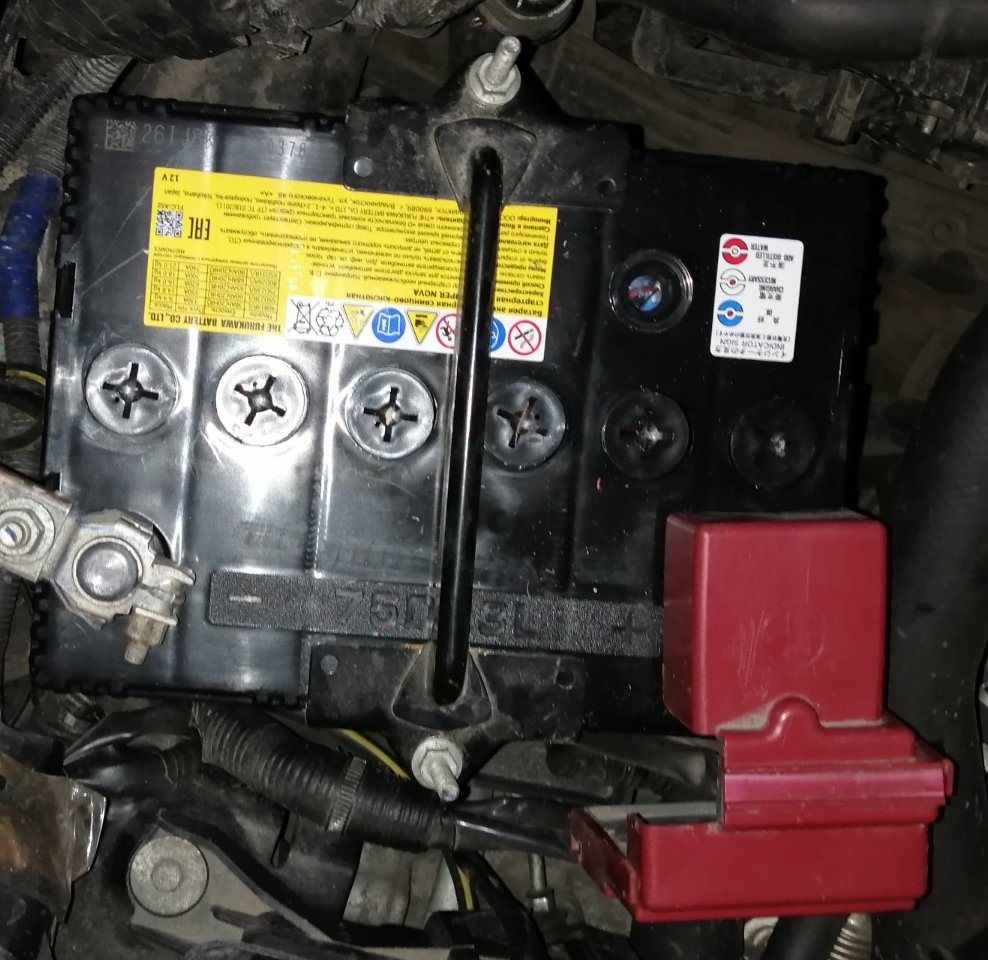
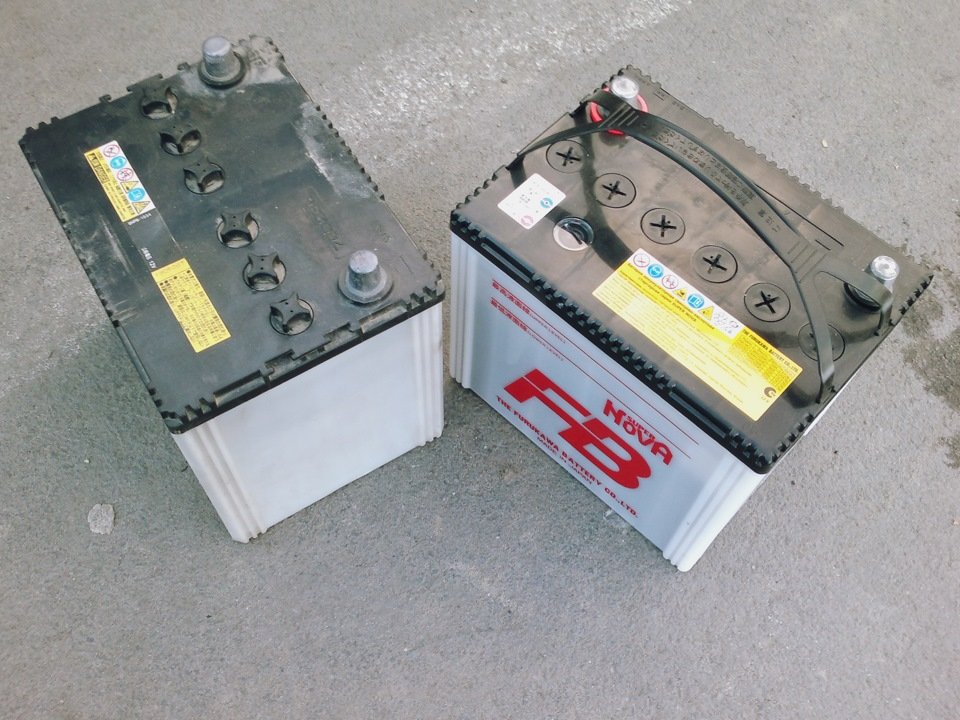
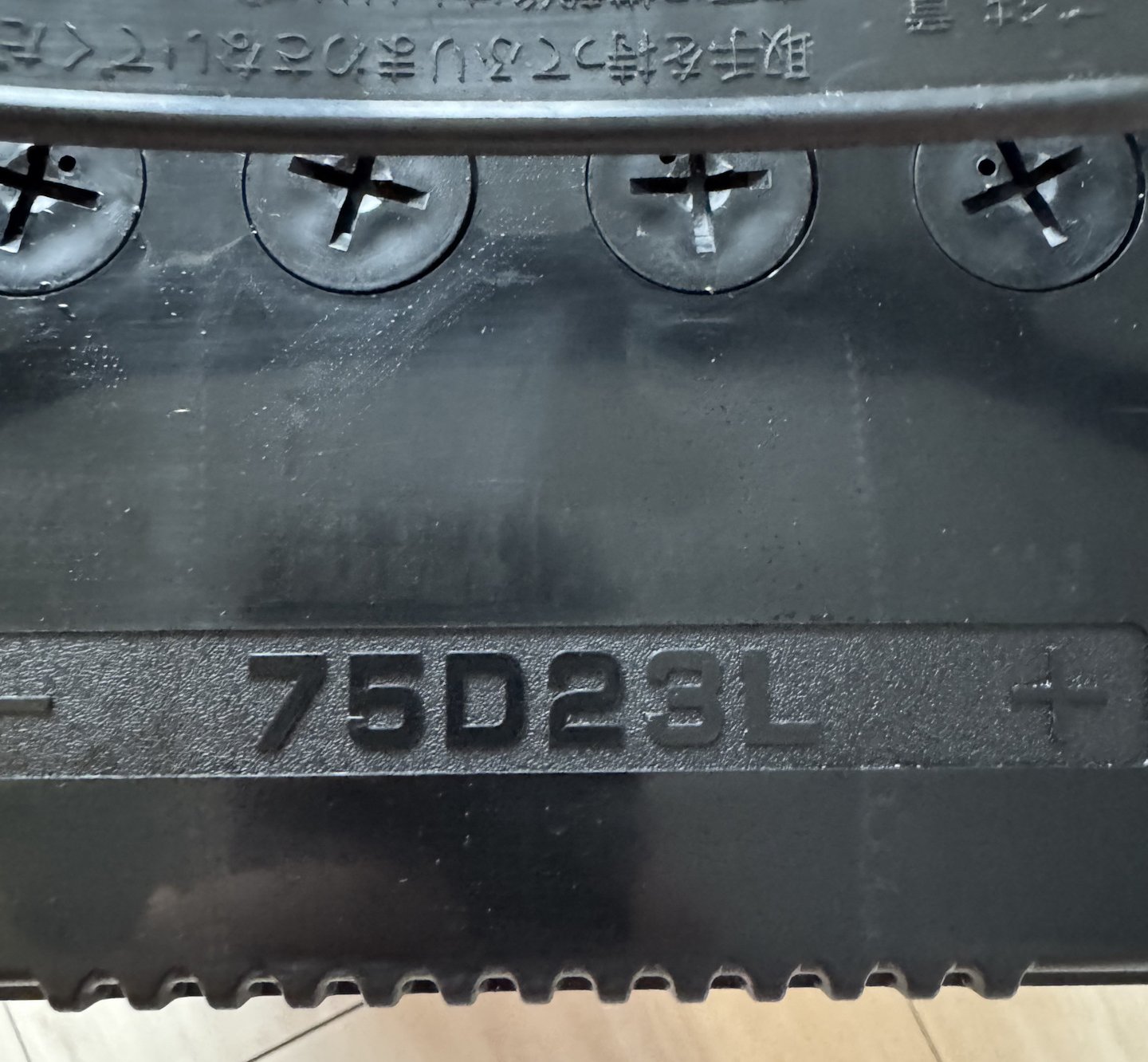
We continue to expand our series of reviews dedicated to deciphering battery markings for Japanese, Korean, and Chinese vehicles. Since Asian battery manufacturers use labeling systems that often differ from European standards, car owners frequently wonder how to correctly interpret these combinations of letters and numbers and what information they convey.
In this review, we will take a detailed look at one of the most common Asian battery markings — 75D23L. Our consultants regularly receive calls and messages asking for clarification on this combination and the rules for reading it. To clear up any confusion, we will break down the specifics of the 75D23L designation.
It is essential to understand that Chinese, Korean, and Japanese manufacturers follow their own marking principles. These codes reflect both the technical specifications of the batteries and the specific requirements of the automotive markets in these countries. That’s why decoding labels like 75D23L requires explanation—to help car owners select and use the right batteries for their vehicles.
✴️ The number "75" at the beginning of the marking indicates a specific operational parameter. This value reflects the relationship between the rated battery capacity (in amp-hours, Ah) and its cold cranking current (CCA).
To better understand this relationship or perform independent calculations (considering the conversion of cranking current units from DIN → EN → CCA), by referring to a cold cranking amp (CCA) standards table and calculating the battery capacity, you can use the following formula:
"75" = (√(CCA Nominal Cold Cranking Current (Iᶜᶜᵉ) × RC Nominal Reserve Capacity (Cᵣₙ)) / 2.8)No Need for Complicated Formulas! We've Done the Math for You
✋ Why overcomplicate things with formulas? We've already performed all the necessary calculations and obtained the following results for batteries labeled 75D23. These batteries come in two capacity options:
- ⚠️ Rare Model — 55 Ah
Cold Cranking Amps (CCA): 450–480 A - ⚠️ Rare Model — 60 Ah
Cold Cranking Amps (CCA): 550–580 A - ✔️ Common Model ☝️ Recommended — 65 Ah
Cold Cranking Amps (CCA): 550–620 A - ⚠️ Rare Model — 70 Ah
Cold Cranking Amps (CCA): 600–620 A
⭐ Based on these findings, the 75D23 battery lineup generally includes rare versions with capacities of 55, 60, or 70 Ah, as well as the most common and recommended option—65 Ah, which represents the ⚡golden middle ground⚡.
The key difference among these variations is their cold cranking current, ranging from 450 to 620 A (CCA).
⚠️ Keep in mind: A higher cold cranking current reduces strain on the starter and makes it easier to start the engine in cold weather. However, batteries with higher CCA ratings tend to be more expensive.
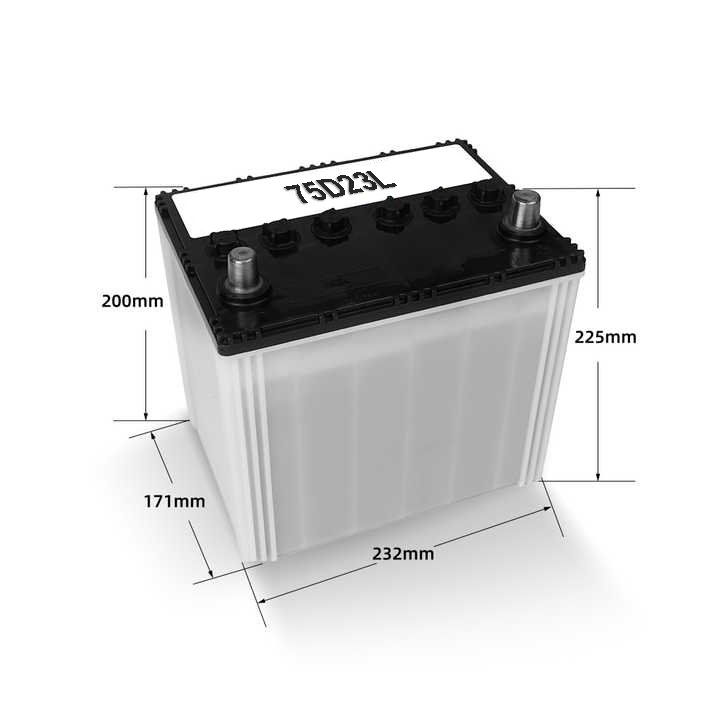
All batteries labeled 75D23L, as well as any others whose markings contain “D23,” share a single standardized size defined as follows:
- Length: 232 mm (23 cm)
Width: 171 mm (17 cm)
⚠️Note: The standard width measurement does not include the protruding lip. In practice, some batteries are made with this lip, and some are made without it. We will discuss this detail further on in this review.
Height: 225 mm (22 cm)
⚠️Important: This measurement includes the terminals because that is how height is recorded in standard tables. If you measure the battery without the terminals, the height will be about 206 mm. We will explain the differences in measurement and the specifics of the terminals later in this review.
In the following diagram, we will clearly show how to measure the main dimensions of a 75D23L battery according to the standard. This ensures there is no confusion when comparing different models.
We’ve taken a detailed look at the dimensions of batteries labeled 75D23L and other models featuring the D23 marking. Naturally, you might wonder: What do these individual parts—“D” and “23”—stand for? Let’s break them down one by one.
The letter D indicates one of the standard automotive battery form factors. There are eight such groups in total, labeled A through H. Each letter refers to specific width and height values for the battery case (not including the height of the terminals). Below are the approximate dimensions for each group:
- A: width ~125 mm, height ~160 mm
- B: width ~127 mm, height ~200 mm
- C: width ~133 mm, height ~204 mm
- ⭐D: width ~170 mm, height ~200 mm⭐
- E: width ~173 mm, height ~209 mm
- F: width ~180 mm, height ~210 mm
- G: width ~220 mm, height ~210 mm
⚠️Note: The battery height here is measured only up to the top cover (excluding any terminal height that extends above the cover).
Meaning of the Digits «D» «23»
The digits (for example, 23) indicate the length of the automotive battery, rounded to the nearest whole centimeter. So, if you see a marking like D23, it means:
- The battery width and height match the D group (width: ~170 mm, height up to the top cover: ~200 mm).
- The battery length is about 23 cm.
By understanding the letter group and the digits in the marking, you can easily identify both the form factor (width and height) and the approximate length of the battery, ensuring you choose the right fit for your vehicle.
- L (Left)
If the marking ends with “L,” it means the negative terminal is located on the left side. - R (Right)
If the marking ends with “R,” it means the negative terminal is located on the right side. - No Letter
If there is no letter following the battery’s alphanumeric marking (which is uncommon in practice), it indicates a non-typical or non-standard terminal placement.
✔️Tip: Knowing which side the negative terminal is on is important for correctly installing the battery in your vehicle. We’ve included a schematic in the next photo to help you visualize how to determine the polarity.
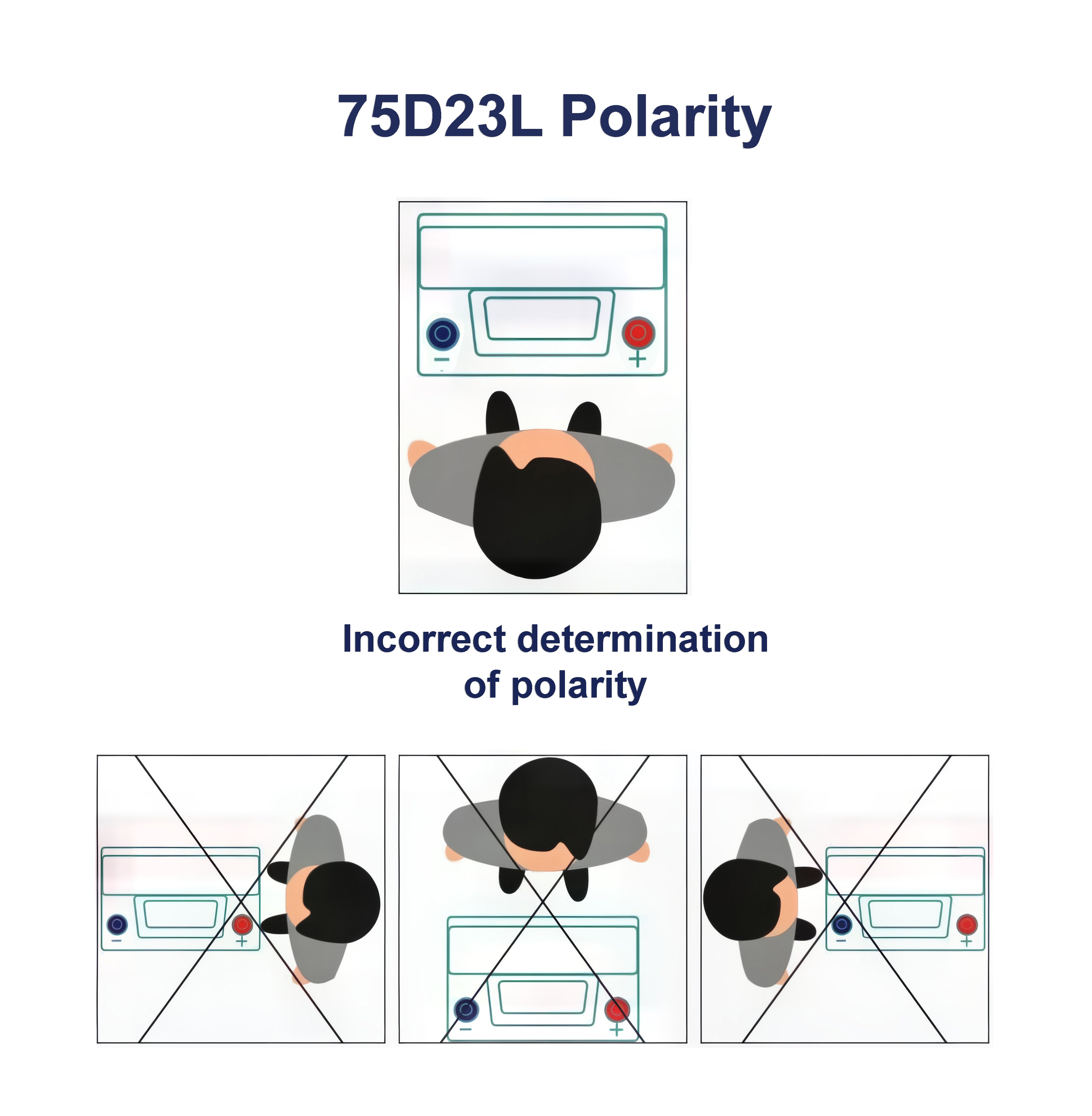
When choosing a battery labeled 75D23L, an extra challenge often comes up: manufacturers typically don’t specify if it’s compatible with cars that have a Start-Stop system. For example, models like the Mazda 3 i-Stop, Hyundai, Kia, and many others require stronger batteries, but the standard 75D23L marking doesn’t clearly show whether it’s suitable for these vehicles.
What Is a Start-Stop System?
If you’re not familiar with Start-Stop technology, here’s a simple explanation: the engine automatically shuts off when the car stops (for example, at a red light) and restarts as soon as you press the accelerator. This process can happen dozens or even hundreds of times a day, putting extra strain on the battery. Because of this, Start-Stop vehicles need special types of batteries:
- EFB (Enhanced Flooded Battery) – The most common option in many Asian-manufactured cars, reinforced compared to standard batteries.
- AGM (Absorbent Glass Mat) – More durable and powerful than EFB, though typically more expensive and therefore less common in Asian-manufactured vehicles.
Conventional batteries without EFB or AGM technology are not designed for frequent charge-discharge cycles, making them unsuitable for Start-Stop systems.
❗Important Note
The 75D23L marking does not indicate whether the battery is compatible with Start-Stop systems. However, many manufacturers add an extra label—often reading “For Stop-Start”— to show that the battery meets the requirements for cars with Start-Stop technology.
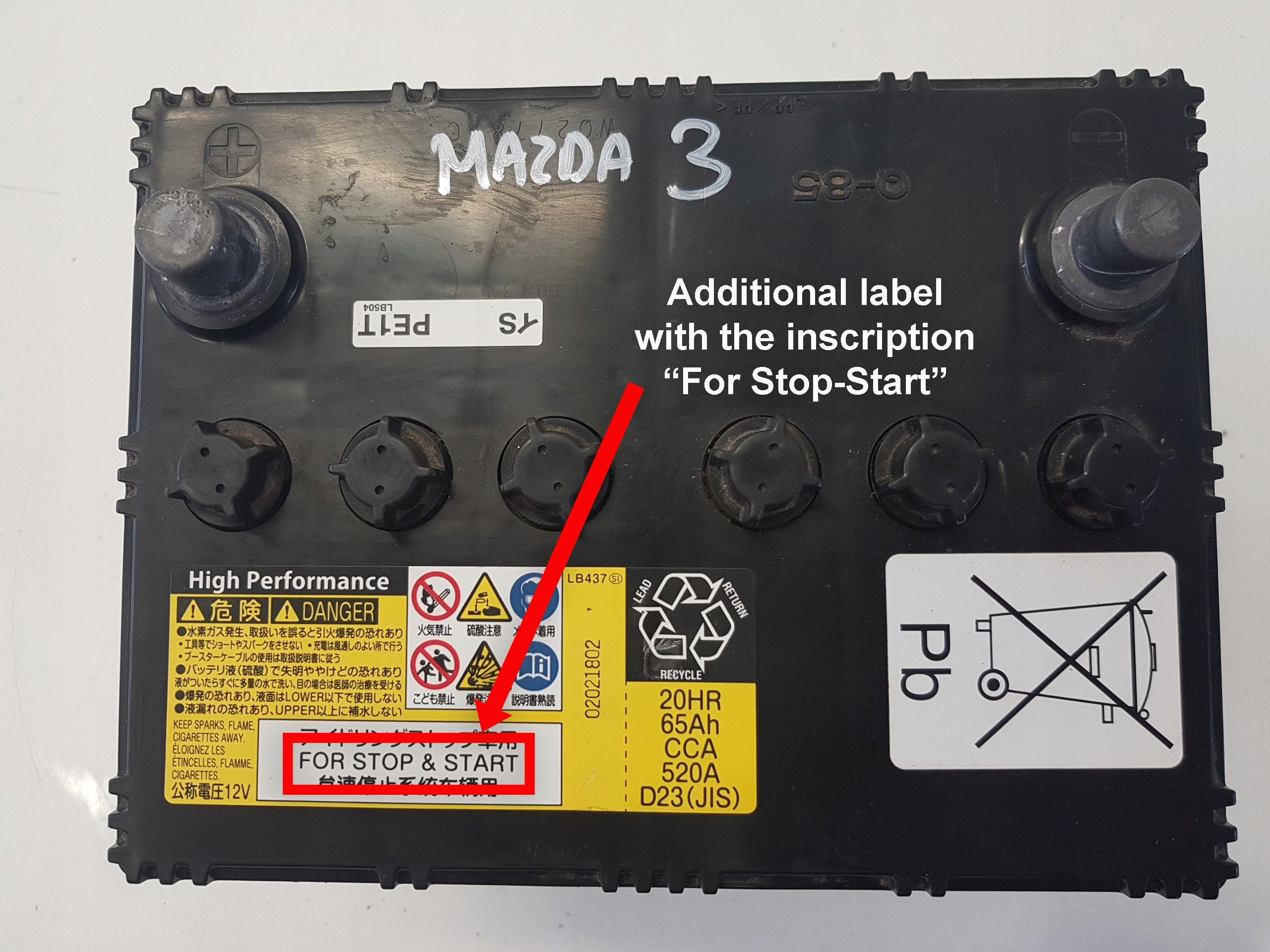
If you need a battery for a car with a Start-Stop system, don’t rely only on the marking—always check the additional label for more details (as shown in the photo).
If your vehicle has Start-Stop, you definitely need a 75D23L battery designed specifically for Start-Stop systems. The best overall choice is EFB, while the most reliable and long-lasting option is AGM.
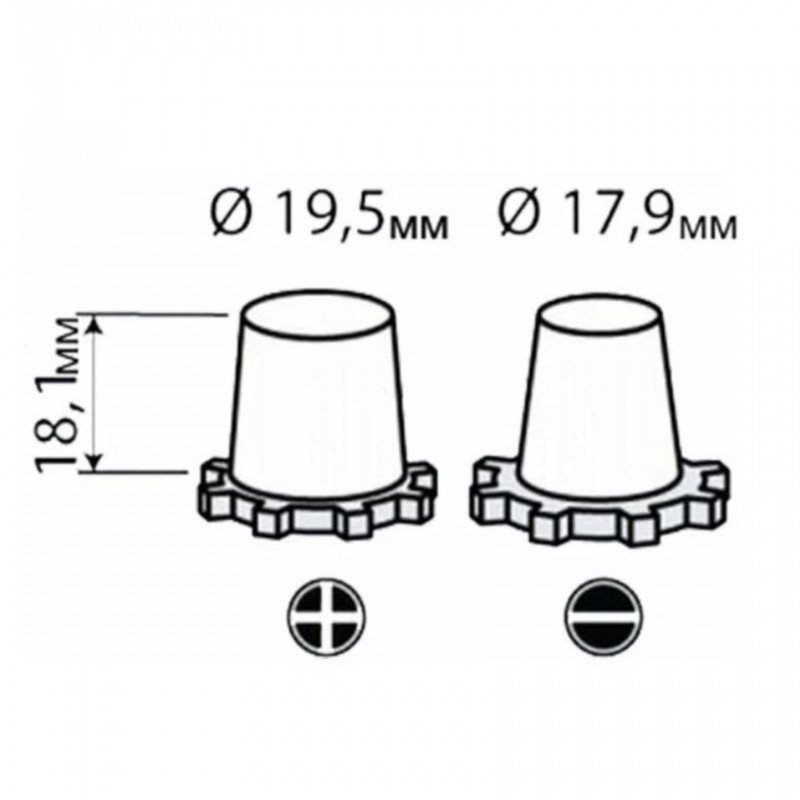
Batteries labeled 75D23L come with a standardized terminal design. The positive terminal diameter is 19.5 mm, and the negative terminal diameter is 17.9 mm.
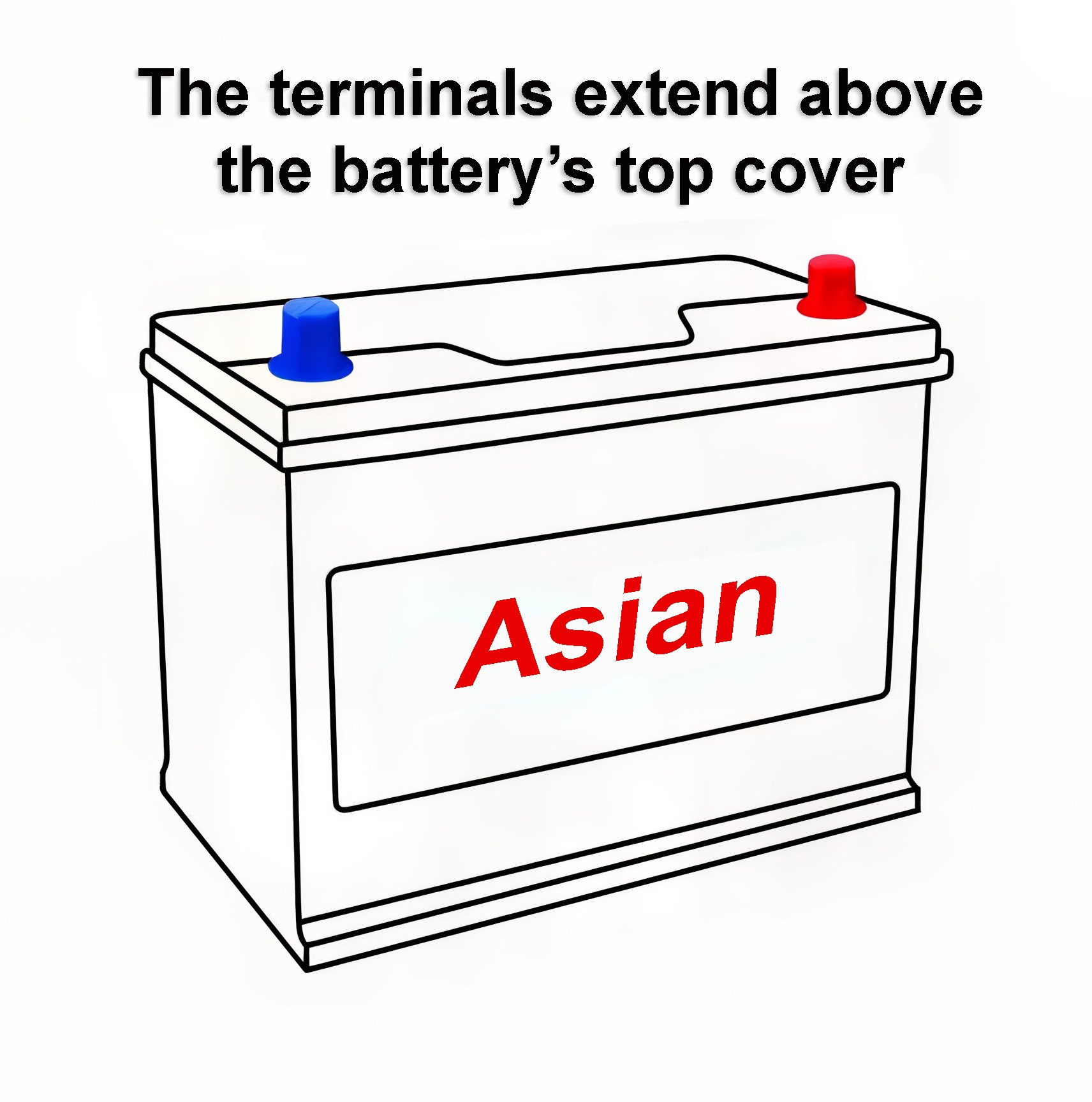
Like all Asian-style batteries, the terminals are positioned above the top cover, which is a distinctive feature of these models.
Sometimes you may see additional markings on batteries, such as 75D23L MF or 75D23L SMF. These abbreviations stand for:
- MF (Maintenance Free) – A “maintenance-free” battery.
- SMF (Sealed Maintenance Free) – A “sealed maintenance-free” battery.
Although both types are technically maintenance-free — which means they don’t require regular topping up with water or electrolyte—there are still a few differences between them.
MF (Maintenance Free)
- Usually has a design that provides limited access to the electrolyte.
- May include special plugs or caps that allow you to add water or measure electrolyte density if necessary. Under normal operating conditions, however, no such maintenance is required according to manufacturer guidelines.
SMF (Sealed Maintenance Free)
- Features a fully sealed case with no traditional openings or easily removable caps.
- Typically equipped with valves (VRLA technology) to regulate internal pressure and vent gases.
- Designed to be completely user maintenance-free, offering a longer service life.
Key Differences
- MF: Partially accessible for checking electrolyte levels and density (if needed or in rare cases).
- SMF: Completely sealed and not intended for external maintenance.
In practice, both types let vehicle owners avoid topping up water and other specialized maintenance. They offer reliable performance throughout their lifespan, with SMF considered a more sealed version of MF due to its construction, gas venting system, and degree of airtightness.
When choosing a 75D23L battery, there’s often an extra consideration: manufacturers don’t always specify whether the battery has a lower “skirt” (a protruding bottom section used for mounting). Meanwhile, many Hyundai and Kia models secure the battery from underneath, using this extended part of the case:
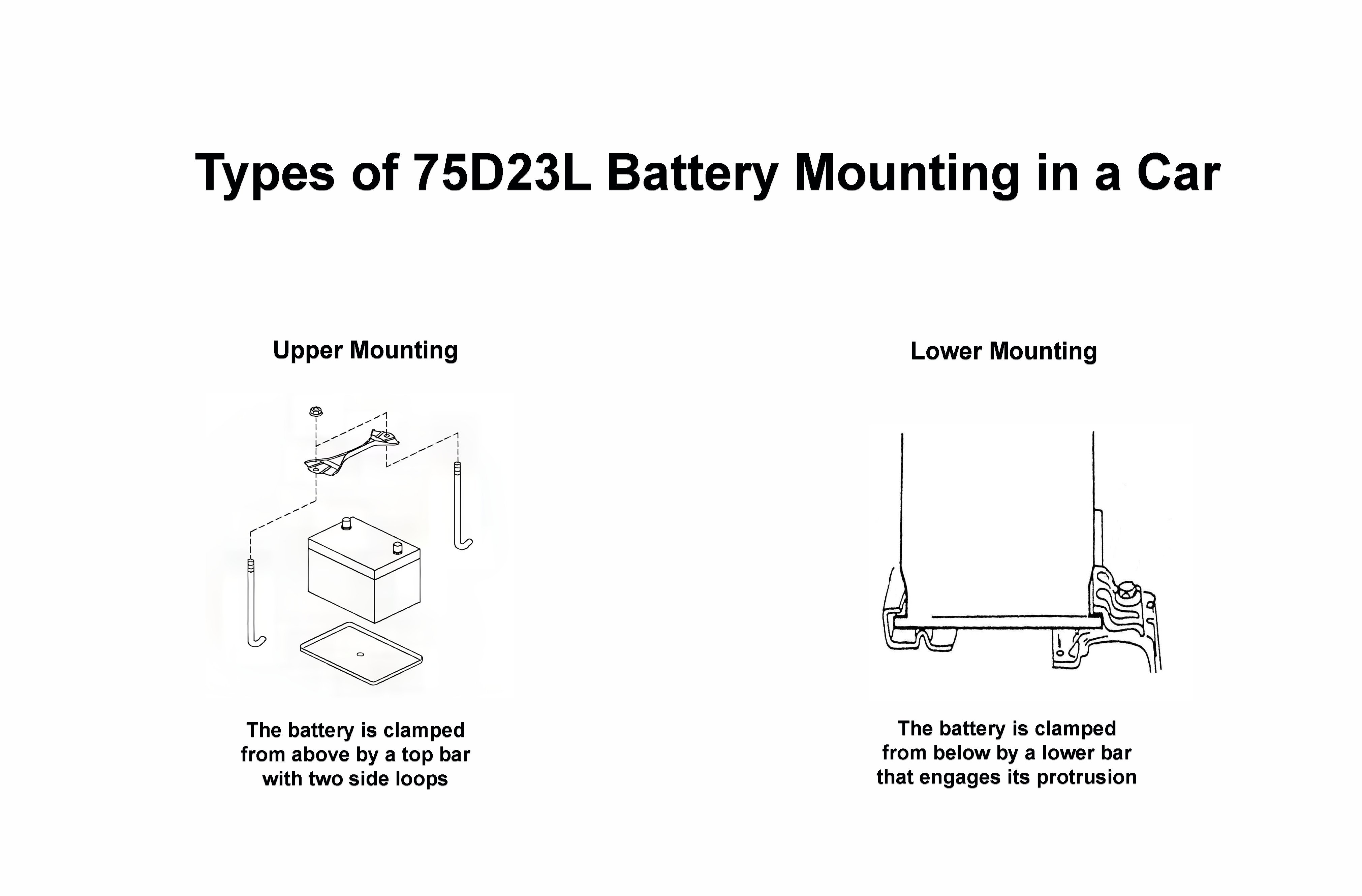
To determine exactly which battery your car needs, start by checking how it’s secured in the vehicle: from the top or from the bottom. If your car uses top mounting, then any 75D23L model will work, regardless of whether it has a lower protrusion (often called a “skirt”). However, if the battery is secured from underneath, it’s essential that the 75D23L battery you choose is equipped with a “skirt”:
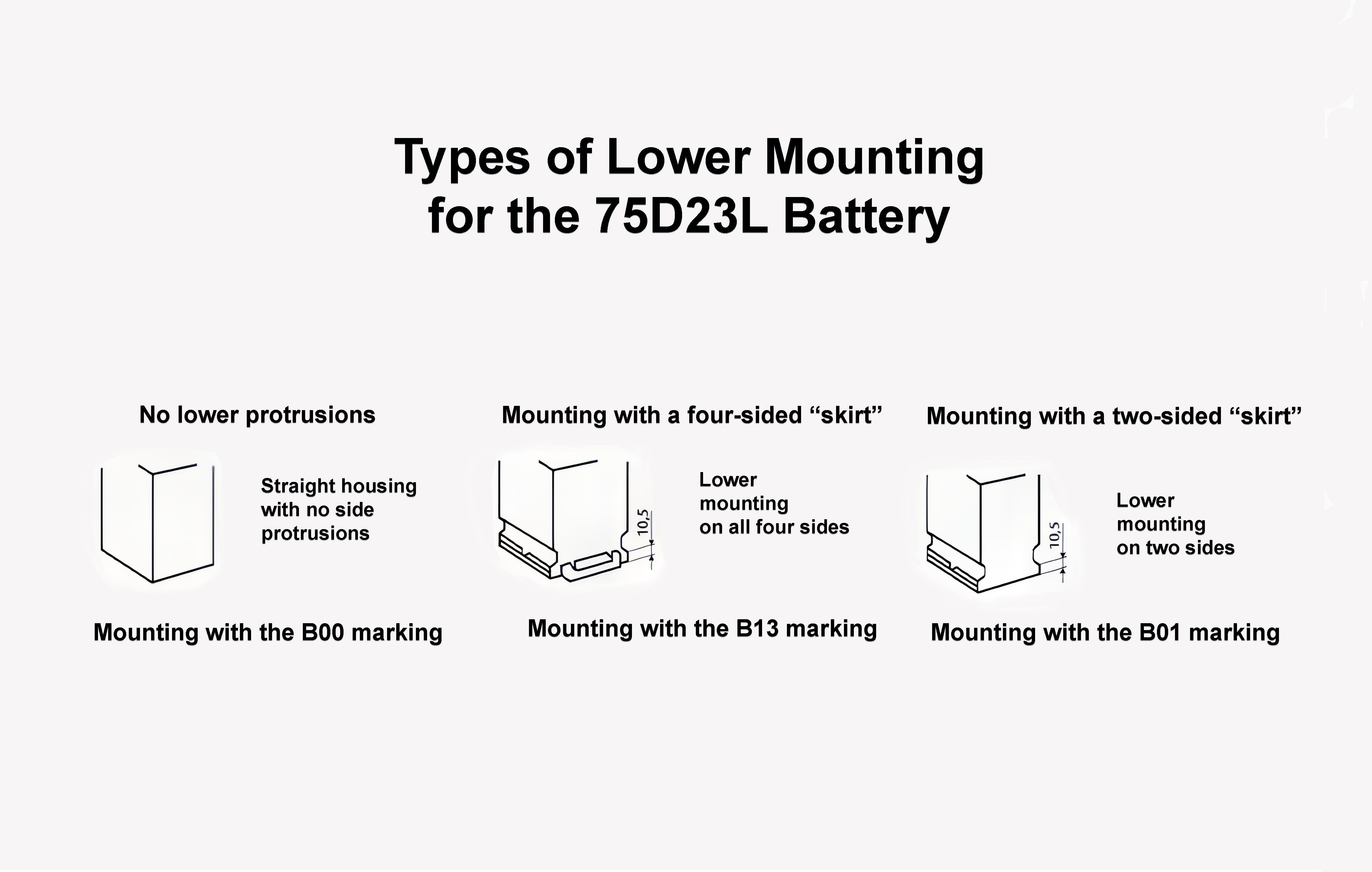
Without a lower “skirt,” the battery won’t be properly secured, leading to an unstable installation and possibly causing it to loosen while driving.
That’s it! As you’ve seen, decoding battery markings isn’t entirely straightforward, but it’s also not particularly complicated.